


November 6, 2025
Learn about the Scrum Master: Agile guide to "unknown" figures in the ICT World
March 8, 2024
Among the many figures in the ICT world there are some about whom very little is known, for example, the Scrum Master, the Servant Leader. Find out who this mystery figure is. Read the article now.

Index
- Scrum Master: Role and Functions
- SCRUM Framework and the Agile Methodology: how to survive without getting lost
- Foundations of Scrum Mastering
- The Figures Involved in the Scrum Team
- Scrum Master Responsibilities.
- Conclusion: The Importance of the Scrum Master in ICT Projects.
"But you, what do you do?" "Without going into detail, computer consultant" "Ah so you can tell me why my cell-" "No!" "Then if I can save money by changing gestor..." "I am a Scrum Master."
When we talk about the ICT/IT world there is always a lot of confusion, there are so many jobs, job figures, work methodologies, and each of them has subcategories. Explaining to a layman what you do to support yourself is sometimes not easy, here I will explain one of the many mysterious mythological figures: the Scrum Master- Starting with the basics and going into the specifics.
Scrum Master: Role and Functions
Let's start with the concept of a Servant Leader, because that is what an SM is, a figure who serves as both a leader and a servant.
Servant Leader thus means a figure who, in addition to the classic leadership characteristics (being able to organize, delegate, have foresight, people management, etc...), stands out because he or she is able to hold colleagues accountable, listens to them, shows empathy, and above all works to eliminate problems and simplify activities.
One SM, in addition to doing all this, promotes the framework SCRUM, ensuring that all principles and rules are followed. Let us see in the next section what the scrum framework is.
The role of the Scrum Master in the software lifecycle
The Scrum Master simplifies software lifecycle management, mainly in the implementation phase, where it supports developers, helping them work unhindered and improving communication between parties, preventing misunderstandings.
Does it also work on large projects?
Indeed! As a concrete example we could take a company that wants to implement a digital transformation. This would greatly impact every area of the company, so proceeding with small incremental releases would help keep the structure stable without having to make a change too abruptly. Specifically, the Scrum Master figure, who focuses on untangling impediments, would make the work smoother and less stressful for all impacted figures
Let's now see together what the Scrum Framework is and how to organize a software development process with this methodology. But if you want to go deeper into the concept of digital transformation, I recommend my article.
SCRUM Framework and the Agile Methodology: how to survive without getting lost
Above I mentioned the expression SCRUM Framework, but what is meant by it?
Scrum is a Framework, i.e., a set of processes and techniques that ensures the development of complex applications following an agile mode, thus with continuous releases and continuous increments of value.
Confused, right?
Let's go by points. The agile methodology aims, according to the Agile Manifesto of 2001,the full customer satisfaction by lowering development time and cost. It does this by giving the opportunity, in a time frame called Sprint, to review and adjust specifications, even those already released, with iterative developments that add value to what has already been done. Scrum tells how to do this.
Foundations of Scrum Mastering
Scrum is based on the concept of empiricism, that is, knowledge comes from practice, and it is well known that practice leads to perfection.
The three pillars on which empiricism is based are:
- Transparency: based on a common language, sharing of activities, and a clear definition of what can be considered finished, done (definition of done)
- Inspection: frequent inspection to verify that progress is meeting established goals
- Adaptation: if after inspection it is found that some requirements are not met, corrective action is taken
The Figures Involved in the Scrum Team
The Scrum team is a self-organized, cross-functional group of professionals. There are no PMs, SMs, PMOs, etc. and they organize themselves for the best management of activities.
The team is divided into three figures:
- The Project Owner (PO): has full vision of the product and customer needs. Manages and prioritizes the Product Backlog (the activities to be performed) and ensures that the team delivers value to the business
- The development team: usually under ten people, responsible for delivering the product and producing the value added on it
- The Scrum Master: finally we talk about him, the mythological figure the Servant Leader. He is a managerial figure serving the team. He ensures that the Scrum Framework is adhered to and removes impediments
Added to these is a figure outside the team, the Stakeholder, or customer
But now let's look in detail at who the Scrum Master is and then see how the ceremonial takes place. Continue reading.
Scrum Master Responsibilities.
Now that we have a general overview we can get more specific about the figure of the Scrum Master.
As mentioned earlier, the SM is a Servant Leader. This expression is used to refer to a management figure who instead of "raining requirements" on developers and giving deadlines provides guidelines to the team on how to train, self-manage, and collaborate.
The SM must be empathetic, seeking to create a work environment that avoids confrontation, external threats and helps team cohesion.
It sees each member as a professional, and as such is treated, encouraged and supported in activities.
In addition to this human part ensures transparency in requirements, helping the PO in organizing the Backlog and helps all team members to comply with the Scrum Framework. In summary the Scrum Master:
- Teaches autonomy
- Empower
- Simplifies activities
- It simplifies relationships between people
- Create a positive environment
- It makes the work as transparent as possible.
To do this, we rely on what are called ceremonies:
- Daily Scrum
- Sprint planning
- Sprint Review
- Sprint Retrospective
Read on to learn more about ciascuan phase of the Scrum ceremony.
Daily Scrum: a good day is seen in the morning
Let's start with the one in which the* MS is not required to participate.
It is usually held every day always at the same time and place and lasts about fifteen minutes. It has the purpose of alignment and can be summarized with three questions: what have I done? What am I going to do? Are there any impediments?
In this case, the task of the* MS is for the duration to be respected and for the MS to intervene in case of impediments or doubts to debar them.
Sprint Planning: Flight Plan for Success
This ceremony answers the question what are we going to do in this sprint? This event marks one.
The whole team participates to decide what the activities, or rather tasks, to be performed will be.
While the Project Owner clarifies goals and priority activities, and the Development Team verifies which activities are actually needed to be carried out, how to assign them, and which to postpone.
Fundamental is the task of the Scrum Master who must cross-fertilize the needs of both parties by guiding the OP to understand what is really needed and the Development Team to understand the needs of the former and the real capabilities that can be employed by the team without having to change the plan on the fly.
In this event, it may happen that we notice impediments or holes in the demands that it is the SM's job to be able to clear or guide to those who can clear them
Sprint Review: the Moment of Truth
The team presents to stakeholders what has been done, that is, what was considered DONE during the sprint.
This is the moment of confrontation between the team and the outside worldand is the time when external figures provide feedback to the team.
It is not a simple presentation of the product. The SM in this case can guide the development team and the PO to expound on why some activities were chosen over others, how they were performed, and what is the actual value added over previous work.
This last point is very important because it can happen that in a sprint where the work has focused on the back-end part the stakeholders are not clear about what improvements the product may have had
Sprint Retrospective: in Search of the Ghosts of Sprints Past.
As the author of this article says "The* Scrum Master has to say that everything is fine even if everything is not fine but then he has to do everything to make things fine" The author of this article is a bit twisted, forgive him.
The Sprint Retrospective is what gives the stop to the sprint. The last ceremony and perhaps the one where the weight of the* MS is most felt.
Questions are answered:
- What went well?
- What can be improved?
- What actions can we take?
- How was the last sprint(s) experienced? (this is an extra)
- Are you sure about the job you have chosen? (Developers know how often they wonder)
The purpose of this ceremony is not just to complain, blame each other or celebrate achievements. It is really to take a critical view of what has happened and how the work can improve.
The purpose of the SM is to guide the team to expose themselves, to listen and above all not to take it personally.
Turning a controversy into advice and helping to understand what actions can be taken.
Guide communication, if necessary with exercises, focusing on what is or is not gone. These exercises help expose yourself without taking frustrations out on others. One of these might be "Compare your experience to a food." Depending on the answers you can figure out how it went. Emphasizing a bit:
- If a member of the vegan team compares it to a florentine, it may be that he felt forced to do more than he should or things that he thinks are wrong
- If it is compared to carbonara with cream you can guess that it went well, but there was something wrong with it
- If it compares to pizza, well, there is nothing to add.
These exercises help focus on what went well, what needs improvement, and what actions can be taken.
Once these questions have been answered, a table can be created where the answers can be entered, and at the next Sprint Review, the MS can see if and why the actions to be taken have been taken.
This ceremony makes it possible to create a positive and relaxed environment where the whole team can feel respected and consequently not worry about having a say in various activities, improving not only self-esteem and rapport among the various members but making them feel professional.
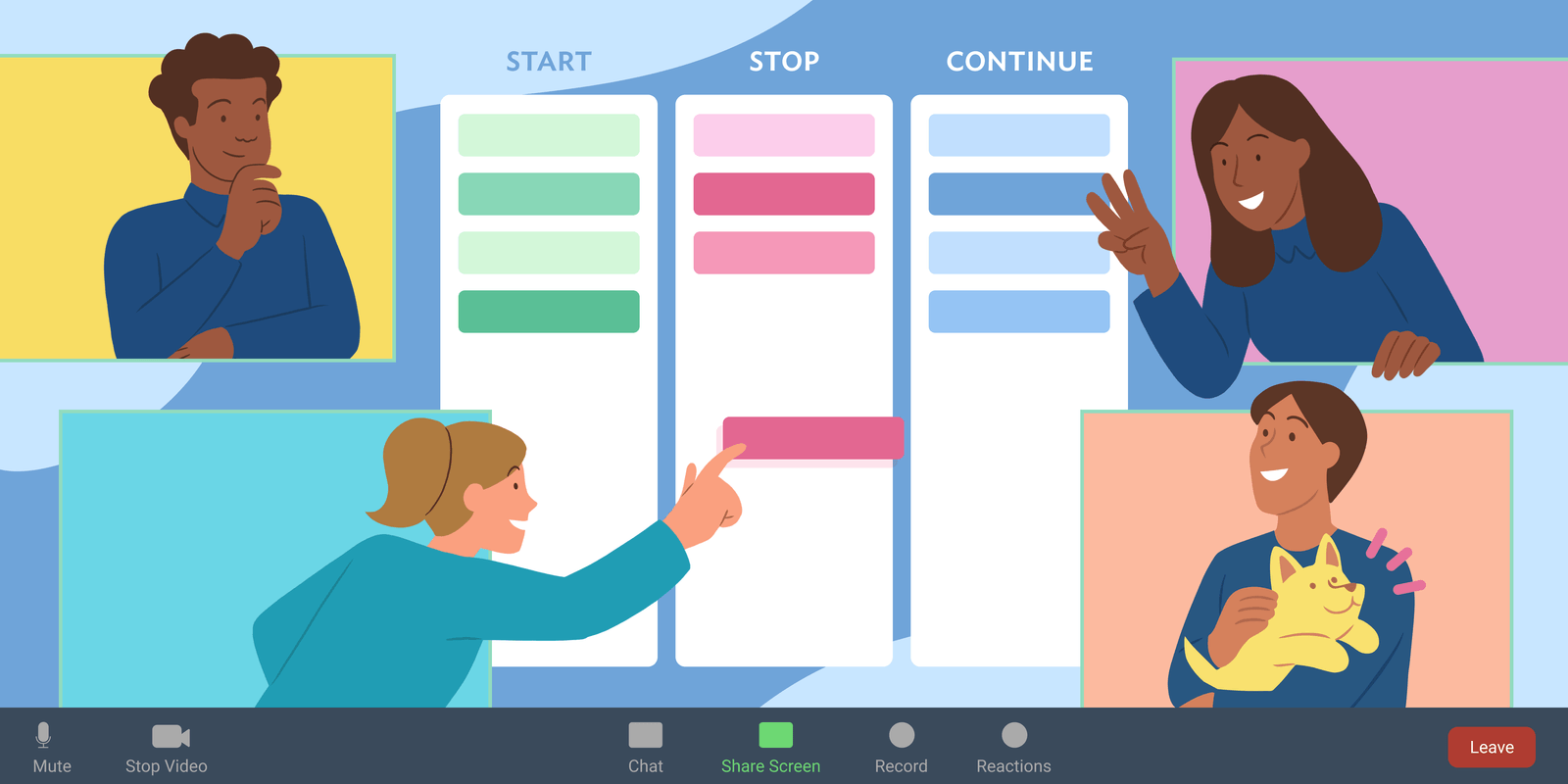
Sprint retrospective Source: clockwise
Conclusion: The Importance of the Scrum Master in ICT Projects.
In closing, the Scrum Master emerges as an indispensable figure in ICT projects in which agile methodologies such as Scrum are adopted. His usefulness manifests itself in projects where complexity and speed of change require a flexible and incremental approach. In particular, the Scrum Master proves invaluable in digital transformation or complex software development projects where collaboration, adaptability and effective management of obstacles are critical to success.
Is it therefore an essential figure?
Only if you are working with Agile Scrum mode.
Can it replace a project manager? Absolutely not, they are realities that should not live together.
Is Waterfall or Agile methodology, if Agile, better Scrum or Kanban?
Each reality is unique, and before deciding which methodology or framework to choose, it is necessary to analyze every part of the business, including needs and habits.